 Yoked
Start with the intake that fits your current training week
Imagine finishing a month of lifting and deciding to eat more. Before choosing a number, ask what you want to change. You might want to reverse a gradual slide in weight during a busy season, support a deliberate weight-gain phase, or simply have enough food available for evening sessions. Each situation calls for a different first step. If missed lunches explain your difficulty getting through workouts, restoring lunch gives you a useful experiment before you calculate anything else.
Maintenance means the average intake associated with roughly stable body weight under your usual conditions. A lifter who cycles to work and coaches soccer on weekends has a different routine during a week off work. Even within the same person, an estimate made in one season can need updating in the next. Write down what your ordinary week includes so that you remember the circumstances behind the number.
If tracking feels comfortable, use a couple of representative weeks of food records alongside body-weight observations taken under similar conditions. Include your usual workdays and weekends. If your weight looks broadly stable across that period, the average logged intake is a starting estimate. A short observation period, missing meals in the log, and changes in activity can all make that estimate less reliable.
What surplus studies tell us about gaining muscle
Helms and colleagues compared lifters assigned to maintenance or to estimated surpluses of five or fifteen percent during eight weeks of resistance training. Faster weight gain was more clearly associated with an increase in skinfold thickness than with changes in muscle thickness. The higher-surplus group did better on the bench press in the group analysis. The same analysis found no clear group effect on squat strength or muscle thickness. Only 17 participants completed the study, which limits how precisely it can guide an individual target.
Garthe and colleagues followed elite athletes through an eight-to-twelve-week weight-gain phase. The group following a higher-energy meal plan gained more total body weight and more fat mass. The researchers did not detect a difference between groups in lean body mass gained. These athletes also trained for their sports, which matters when applying the findings to someone lifting around a desk job.
Together, these studies give limited support for chasing faster scale gains in hopes of proportionally faster muscle growth. They leave the best calorie target for an individual uncertain. A modest addition that you can repeat and evaluate gives you a practical place to start if you want to gain weight gradually. If training is progressing and you are comfortable at your current weight, maintaining your current routine is also a reasonable choice.
Evidence: Helms et al. (2023), small and large energy surpluses in trained lifters
Evidence: Garthe et al. (2013), nutritional intervention in elite athletes
Work through a starting target
Consider Alex, a fictional adult lifter whose weight has been broadly stable through several ordinary training weeks. Alex has checked two complete weeks of food records. Week one totals 16,450 calories and week two totals 17,150 calories. Together that is 33,600 calories over fourteen days, or about 2,400 per day. Differences between days are expected when meals and schedules vary.
Alex wants to test a small increase and chooses five percent as an example. Multiplying 2,400 by 0.05 gives 120 calories. Adding 120 gives a trial average of 2,520 calories per day. The arithmetic is exact for those inputs, but the food records and the estimate of maintenance carry uncertainty. Alex writes down the starting date, usual training schedule, and the change to make at breakfast.
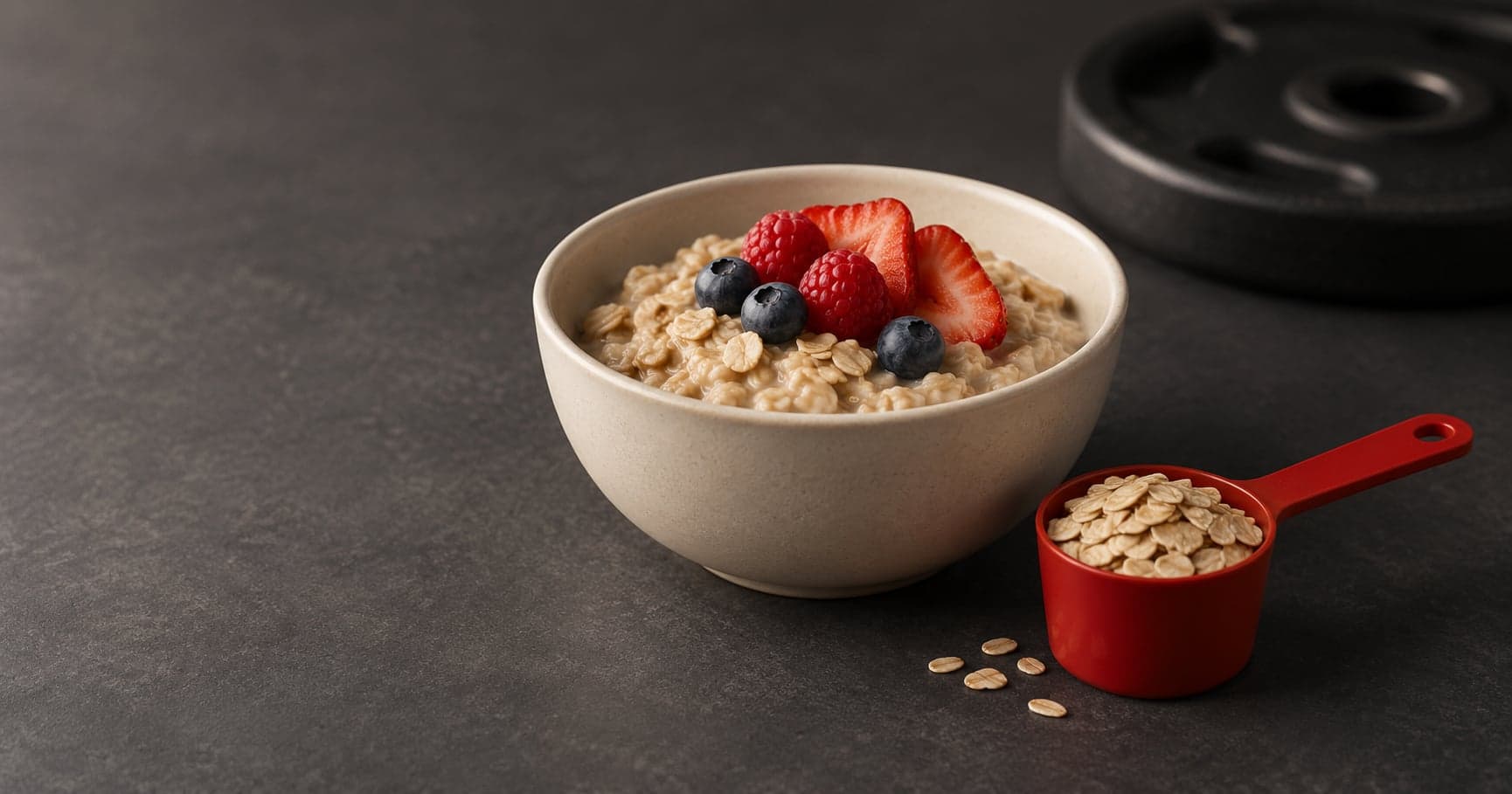
A practical way to implement the trial is to add a familiar food in an amount estimated from its own label. If the oats in Alex’s cupboard list 150 calories per 40 grams dry, an extra 32 grams dry would supply about 120 calories by that label. A different brand or preparation can have a different serving description. Someone who dislikes a bigger breakfast could make a comparable addition at lunch instead.
| Calculation | Result |
|---|---|
| 16,450 + 17,150 calories over two weeks | 33,600 calories |
| 33,600 ÷ 14 days | 2,400 calories per day |
| 2,400 × 0.05 | 120 additional calories per day |
| 2,400 + 120 | 2,520 calories per day on average |
Choose a routine you can actually compare
Keep the first trial simple enough to remember on a busy day. Alex might leave a note beside the breakfast bowl and review the first few entries for serving-size errors. Repeating the same addition also makes it easier to spot a problem with the choice itself. If the extra oats make breakfast uncomfortable before an early workout, shifting the addition to a later meal preserves the trial while improving its fit.
A daily average allows room for ordinary variation. Suppose a late shift changes dinner on Thursday. Record what happened and return to the usual routine at the next meal. Trying to settle a calorie debt the following morning makes the plan harder to interpret and can interfere with hunger and comfort. The question at review time is what pattern you managed across the week.
When logging in Yoked, search for the food, scan its barcode, or review an editable meal estimate. Check the portion and whether the entry describes dry or prepared food. Using the label for dry oats with the weight of cooked oatmeal can change the estimate considerably because cooking adds water. A saved recipe can make repeated breakfasts easier to enter once the ingredients and portions look right.
For help turning a food adjustment into a grocery list, see the meal-planning routine.
Read the trend alongside your training log
At the end of the trial, look at several weeks together. If you choose to weigh yourself, use a similar time of day and comparable conditions, then compare averages across similar weeks. One measurement after a large dinner and another before breakfast make a poor pair. If frequent weighing is unwelcome, use a simpler meal routine and discuss your goals with a registered dietitian if you want more tailored guidance.
Alongside intake, note whether you completed the sessions you planned and how comparable exercises went. An extra repetition on the same lift at a similar effort is useful training context. A change of gym, equipment, or exercise order can make that comparison less informative. Neither a better workout nor an upward weight trend reveals exactly how much muscle you gained.
For Alex, a decision after several consistent weeks might be to keep breakfast as it is if weight is gradually moving in the desired direction and the routine feels good. If the trend is flat, first check whether the extra serving actually happened and whether activity changed. Four missed breakfasts during travel suggest a scheduling issue. Increasing the written target would leave that problem unsolved.
For a way to interpret changes in your lifting log, see the guide to progressive overload.
Decide what to change at the next review
If the plan was easy to follow, activity was similar, and weight is still stable when gradual gain is the goal, choose one further modest food adjustment and record it. If weight is rising faster than you intended across repeated observations, scale back the most recent addition and reassess. Keep the rest of the routine recognizable so you can tell which change you are evaluating.
There are weeks when the most informative choice is to wait. A new training program, a demanding travel schedule, or a stretch of illness can make a comparison hard to read. Resume your usual routine and collect a more representative stretch before drawing conclusions. Persistent unexplained weight change, difficulty eating enough, or distress around tracking deserves individual attention from a qualified clinician or dietitian.
Leave yourself a short handoff for the next review. Alex’s might read, “Usual intake averaged about 2,400. I added oats at breakfast on workdays and weekends. I will review my food record, weight trend, and comparable lifts after several ordinary weeks.” That note preserves the reasoning behind the target and gives you a concrete way to revise it when your schedule or goal changes.
Sources & editorial notes
Written by Yoked with AI assistance. Examples are starting points for generally healthy adults, not individualized medical or rehabilitation advice.
- Helms et al. (2023), small and large energy surpluses in trained lifters — Eight-week primary study comparing estimated surpluses and maintenance. Outcomes included strength, muscle thickness, and skinfold thickness.
- Garthe et al. (2013), nutritional intervention in elite athletes — Randomized study of 39 athletes during a weight-gain phase. Measured changes in body weight, fat mass, lean body mass, and performance.