 Yoked
Plan the difficult meals first
A meal plan earns its place when it solves a real problem. Perhaps you train after work and arrive home hungry, or lunch depends on whatever is available near the office. Start with that recurring situation. You do not need to replace every familiar breakfast and family dinner with a new recipe to make the week easier.
Open your calendar and count the meals you expect to eat at home, carry with you, or buy elsewhere. Note access to a refrigerator, microwave, and cooking equipment. A packed meal that cannot be stored safely at work is not a workable solution. Choose a different option rather than pretending your usual day will change to fit the plan.
For the first week, consider covering three work lunches and one late dinner. Keep the other meals flexible. This is an organizational starting point, not a nutrition prescription. If cooking four portions is already too much, start with two or assemble meals from suitable ready-to-eat ingredients.
Choose meal components you enjoy repeating
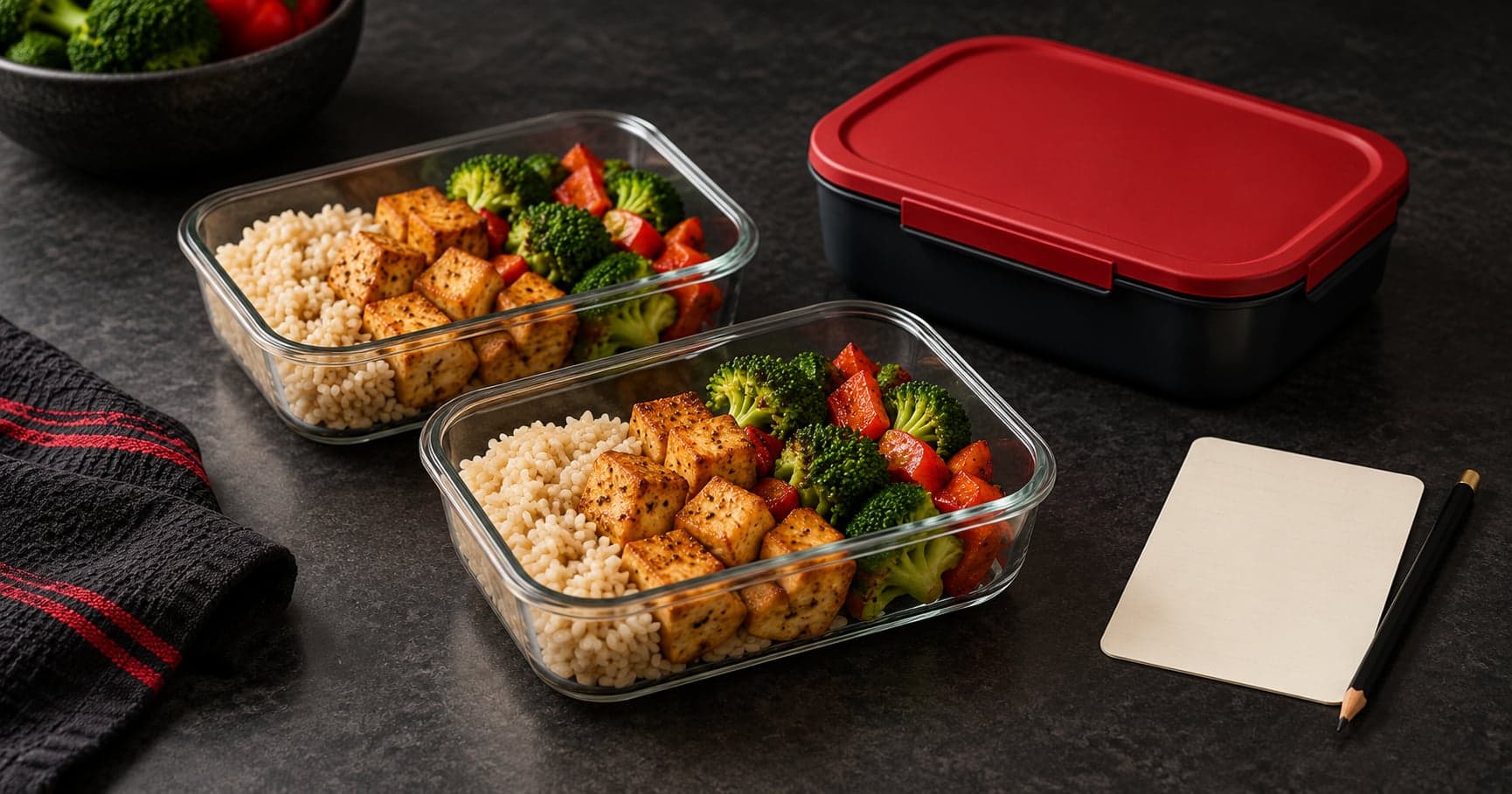
Pick a protein food you like, a carbohydrate food that fits the meal, and vegetables or fruit. Add fats, sauces, and seasonings according to the recipe and your preferences. For example, tofu, rice, broccoli, and a sauce can become one lunch; beans, a baked potato, salsa, and vegetables can become another. These combinations are examples, not nutritionally identical substitutions.
Protein matters in resistance-training nutrition: a large meta-analysis found benefits from protein supplementation during prolonged training in healthy adults. That finding does not require a particular meal container, recipe, or supplement. Establish an appropriate daily target separately, then choose ordinary foods and portions that help you meet it. The planning task here is making those choices available when you need them.
Check allergies, dietary requirements, and ingredient labels before copying a menu. If you have a prescribed diet, use that as your starting point. Someone managing a medical condition or needing individualized nutrition advice should work with a qualified professional rather than treating this general example as a personal plan.
Evidence: Morton et al. (2018): Protein supplementation and resistance training
For the separate question of how much protein to plan, see the protein-target guide.
Turn portions into a shopping list
Write the number of servings before listing ingredients. In this fictional example, one person wants tofu-and-rice bowls for Monday, Tuesday, and Wednesday lunch, plus a late Monday dinner. That is four portions. Assume their chosen recipe uses 150 grams of drained tofu, 60 grams of dry rice, and 150 grams of vegetables per portion. These amounts demonstrate shopping arithmetic; they are not a recommended serving size for every lifter.
Multiply each ingredient by four, then subtract what you already have. If there are 120 grams of dry rice in the cupboard, the recipe needs another 120 grams. Buying a larger package is fine if it fits your budget and storage space; record the leftover quantity for another week. Check package sizes and drained weights rather than assuming that one package equals one meal.
Keep sauces and cooking oil on the list too. Their quantities come from the recipe, and they belong in the meal estimate if you track it. Avoid mixing dry rice weights with cooked rice entries. Use the preparation state that matches your measurement, and keep it consistent when you repeat the meal.
| Ingredient | Per portion | Four portions |
|---|---|---|
| Drained tofu | 150 g | 600 g |
| Dry rice | 60 g | 240 g |
| Vegetables | 150 g | 600 g |
| Sauce and cooking oil | Use the recipe quantities | Multiply those quantities by four |
Use a small preparation session and a midweek reset
Choose a realistic time to cook and clear enough refrigerator space before starting. Check that you have clean containers, labels, and the equipment the recipe needs. Prepare the ingredients in a sensible order, keeping raw animal foods separate from ready-to-eat foods if you use them. Follow the recipe and safe cooking guidance for your ingredients instead of using appearance alone to decide whether meat is done.
For the four-portion example, cook on Sunday and plan to eat the meals on Monday through Wednesday. Keep a separate midweek option for Thursday and Friday, such as another freshly prepared batch or a suitable frozen meal. This avoids relying on one Sunday batch sitting in the refrigerator for the entire working week.
You can also prepare components instead of complete bowls. Keep the sauce separate if that makes the texture more appealing, or use the same cooked ingredient in two different dishes. Choose one change in flavor rather than several unrelated recipes if kitchen time is the main constraint. The best level of variety is the one you will actually use.
Evidence: FoodSafety.gov: 4 Steps to Food Safety
Evidence: FoodSafety.gov: Safe Minimum Internal Temperatures
Make storage part of the plan
FoodSafety.gov advises refrigerating perishable food within two hours, or within one hour when exposed to temperatures above 90°F/32°C. Divide leftovers into shallow containers and refrigerate promptly for faster cooling. Keep the refrigerator at 40°F/4°C or below. Do not leave a large cooked batch on the counter for hours while you wait for it to become completely cold.
The FDA advises using refrigerated leftovers within three to four days. Label portions with the preparation date and freeze promptly any portions you do not expect to use in that window. Storage instructions for a particular food or package can be more specific; follow them. Freezing is a planning tool, not a way to rescue food that has already been handled unsafely.
When reheating leftovers, use a food thermometer to confirm 165°F/74°C throughout. Follow microwave directions and check more than one spot, especially in a dense bowl. Thawing in the refrigerator is a straightforward option to plan ahead. A meal carried to work needs safe cold storage during transport and after arrival; do not leave it in a warm car or gym bag.
Evidence: FDA: Food Safety Tips for Healthy Holidays
Evidence: FoodSafety.gov: 4 Steps to Food Safety
Evidence: FoodSafety.gov: Safe Minimum Internal Temperatures
Keep a backup meal and make tracking useful
Choose a backup you can assemble on a difficult day. Depending on your preferences and storage, that could be beans with microwave rice and vegetables, or yogurt with oats and fruit. Check the actual product labels and portions rather than assigning a universal protein or calorie value to the combination. A backup should fit your needs, not simply carry a high-protein label.
If you record food, save enough detail to reproduce the meal: ingredients, quantities, preparation state, and number of portions. Dividing a recipe estimate by four assumes four comparable portions. If one container holds much more than another, an equal split is only an approximation. You can portion more evenly or adjust the record rather than treating the app total as exact.
Yoked supports food search, barcode scanning, and editable meal estimates. Use these to record the foods you chose, then review the amounts before saving. An AI-assisted estimate is a starting point to check against the ingredients and labels you have. It does not replace food-safety checks or establish a medical nutrition plan.
Review what happened before adding complexity
At the end of the week, ask which meals you ate, which were left over, and when you still needed an unplanned alternative. If two lunches went unused because meetings included food, reduce the next batch. If the late dinner was the useful part, prioritize that slot. These observations are more actionable than judging the whole week as a success or failure.
Keep portions and food choices flexible as you learn what supports your appetite and training routine. Avoid making a large food change in response to one workout or one day of body weight. If the plan leaves you persistently hungry, uncomfortable, or preoccupied with tracking, simplify it and seek individualized help when needed.
For the next week, keep the easiest meal, change the least enjoyable component, and repeat the shopping calculation. A sustainable routine can be as modest as a short list, two cooking opportunities, and a backup meal. The purpose is to make useful food choices easier alongside training, not to turn every meal into another demanding project.
To coordinate preparation with a manageable training schedule, see the three-day full-body routine.
For fitting non-training days into the week, read planning your rest days.
Sources & editorial notes
Written by Yoked with AI assistance. Examples are starting points for generally healthy adults, not individualized medical or rehabilitation advice.
- Morton et al. (2018): Protein supplementation and resistance training — Research abstract verified November 1, 2026. Supports the relevance of protein during resistance training, not a specific meal-prep schedule or guaranteed result.
- FDA: Food Safety Tips for Healthy Holidays — Official handling and three-to-four-day leftover guidance, checked November 1, 2026.
- FoodSafety.gov: 4 Steps to Food Safety — Official cooling, refrigeration, separation, and hot-weather time limits, checked November 1, 2026.
- FoodSafety.gov: Safe Minimum Internal Temperatures — Official thermometer guidance and 165°F/74°C reheating temperature for leftovers, checked November 1, 2026.