 Yoked
Use a planning target rather than a magic number
Protein provides amino acids used in maintaining and building body tissues. Resistance training creates a reason for the body to adapt, while food supplies the materials and energy that support that process. Eating a high-protein diet without a suitable training stimulus is not equivalent to following a progressive strength program.
Morton and colleagues’ meta-analysis of protein supplementation during resistance training estimated a breakpoint of about 1.6 grams per kilogram per day for additional gains in fat-free mass. Its confidence interval was wide, so this is a practical planning estimate, not a personal ceiling. The research concerns total daily protein from food and supplements together, not 1.6 grams per kilogram of protein powder.
Use the number as a convenient starting point for meal planning. If your current intake is much lower, a gradual increase through ordinary meals may be easier than a sudden overhaul. Once protein is reasonably covered, spending more attention on consistent training, adequate overall food, and a sustainable routine may be more useful than chasing another few grams.
Evidence: Morton et al. (2018): Protein supplementation and resistance training
Calculate your daily amount
Multiply body weight in kilograms by 1.6 to estimate a daily planning target in grams. If you know your weight in pounds, divide by approximately 2.2 first. For a 70-kilogram adult, the calculation is 70 times 1.6, or about 112 grams per day. Round to a practical number rather than trying to eat with laboratory precision.
The calculation is a general shortcut for healthy adults, not an individualized nutrition assessment. Body composition, age, overall energy intake, and medical needs can change how useful a weight-based formula is. At unusually high or low body weights, or when your situation is complex, a registered dietitian can help choose a more appropriate basis for planning.
If you have kidney disease, a prescribed protein restriction, pregnancy-related nutrition needs, or another condition affecting diet, use advice from your clinician or dietitian rather than this article's formula. The examples below are arithmetic illustrations for adults, not treatment plans or recommendations for children.
For the same 70-kilogram example, 112 grams could be organized as approximately 28 grams across four eating occasions. This is arithmetic to help distribute the daily total, not a claim that your body can only use 28 grams at once. Choose actual portions using the label on your food; similar-looking yogurt, tofu, and drink products can have quite different protein contents.
| Body weight | Calculation | Approximate daily protein |
|---|---|---|
| 60 kg / 132 lb | 60 × 1.6 | 96 g |
| 70 kg / 154 lb | 70 × 1.6 | 112 g |
| 80 kg / 176 lb | 80 × 1.6 | 128 g |
| 90 kg / 198 lb | 90 × 1.6 | 144 g |
Build the day from meals you already eat
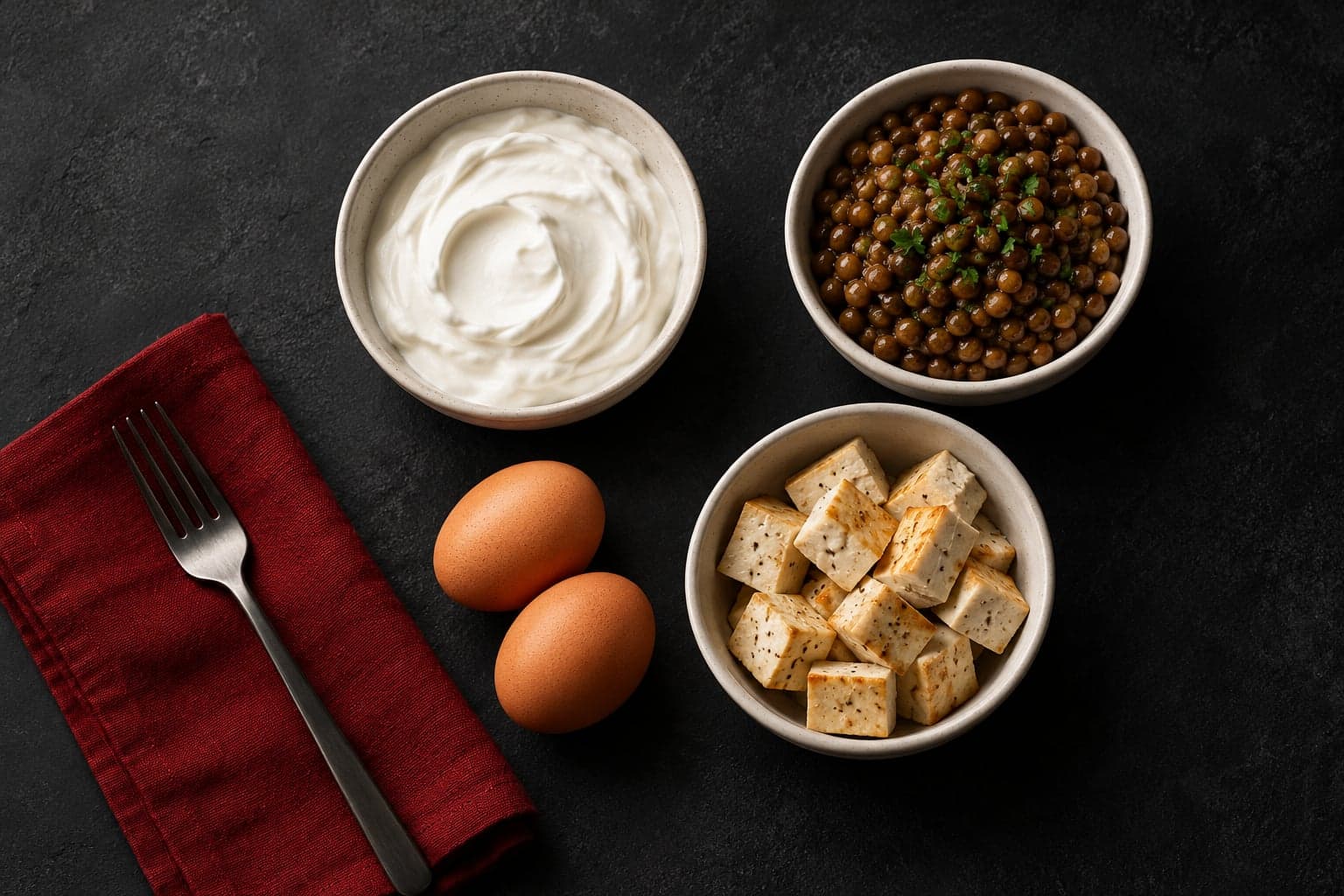
Start by listing a typical breakfast, lunch, and dinner. Identify the main protein-containing food at each meal and check its label or a reliable food entry. It is often easier to strengthen a meal you already enjoy than to introduce an entirely new diet. For example, add yogurt or a suitable soy alternative at breakfast, include beans or tofu at lunch, and plan a clear protein source at dinner.
Divide the daily target across the eating occasions that fit your life. Someone aiming for roughly 120 grams could plan three meals containing around 30 grams plus a snack containing around 30 grams. Someone who prefers four smaller meals could distribute it differently. These are organizational examples, not a rule that every meal must contain an identical amount.
Avoid making dinner responsible for almost the entire day's target by accident. Check your usual breakfast first, because a low-protein morning can make the rest of the day harder to organize. If you dislike breakfast, you do not need to force a specific eating pattern; simply plan the remaining meals intentionally. Consistency is easier when the arrangement matches your appetite and schedule.
| Eating occasion | Possible protein anchor | What to check |
|---|---|---|
| Breakfast | Greek yogurt, eggs, or tofu | Serving size and product label |
| Lunch | Beans with grains, tofu, fish, or poultry | Cooked portion and preparation |
| Snack | Yogurt, milk, soy drink, or optional shake | Actual grams per serving |
| Dinner | Lentils, tempeh, fish, meat, or another preferred source | Total meal contribution |
Choose foods that fit your preferences
Animal and plant foods can both contribute to a useful protein intake. Choose foods you enjoy, tolerate, and can afford. A varied pattern also helps you include fiber, fats, carbohydrates, vitamins, and minerals rather than turning every food decision into a comparison of protein grams alone.
For plant-based eating, give protein-containing foods a clear role in your meals. Tofu, tempeh, beans, lentils, and suitable fortified soy products can make planning more concrete. Portions and preparation matter, and different products vary substantially. Check the actual food you use instead of assuming that every plant milk or meat alternative supplies a similar amount of protein.
Convenience foods can be helpful on busy days, but convenience is not the same as necessity. Keep a few dependable options available, such as canned beans, frozen edamame, yogurt, or foods that suit your dietary needs. The best backup meal is one you can reliably prepare and enjoy, not an idealized recipe that requires a shopping trip whenever work runs late.
Supplements are optional tools
Protein powder can be convenient when ordinary meals leave a gap, but it is not required to build muscle. Compare a serving with other options by cost, taste, tolerance, and the amount of protein it actually provides. A shake does not replace the training process, and adding one on top of an already adequate intake does not guarantee additional benefit.
Read serving instructions carefully. A scoop is a measuring tool, not a universal unit across products. If you use a powder in a recipe, account for the amount used in the whole recipe and the portion you eat. Check allergens and ingredients that affect your tolerance. For athletes subject to substance testing, independent product certification is an additional consideration.
Keep marketing language separate from your decision. Claims about extraordinary growth or a special anabolic window can distract from the basics of regular meals and training. If a supplement makes your routine simpler, it may be useful. If it adds expense, stomach discomfort, or anxiety without solving a practical problem, ordinary food may be the better choice.
Track enough to learn, then simplify
A short period of food logging can show whether your usual meals are close to the target. Use consistent entries and verify portions, especially for foods whose cooked and raw weights differ. A cooked chicken portion and the same numerical weight of raw chicken are not interchangeable entries. Recipes also need a sensible serving count if you want the estimate to be useful.
Treat the results as estimates. Food labels, serving sizes, and database records are imperfect, and daily eating varies. A day a few grams below your target is not a failure that requires late-night compensation. Look at your normal pattern and identify the meal where a small change would make the biggest practical difference.
Yoked supports food search, barcode scanning, and editable meal estimates. Review the selected food and portion before logging, especially when an AI-assisted estimate is involved. The point of tracking is to reduce uncertainty enough to make a useful decision, not to create an exact biological score for every meal.
Keep protein in the wider muscle-building plan
Protein is only one part of the process. If you are regularly too tired to train, unintentionally eating very little, or replacing most carbohydrate-containing foods just to raise protein, review the whole diet. A protein target should fit inside a workable eating pattern, not crowd out every other need or preference.
Pair nutrition planning with a training schedule you can repeat and a method for progressing exercises. You cannot infer that a protein target is wrong from one weak workout. Look at training consistency, recovery, appetite, and longer-term progress together before making a large change. If you want individualized body-composition or weight-management advice, a registered dietitian can help interpret those signals.
For the next week, calculate a reasonable starting target, identify a protein anchor in your regular meals, and check the portions you usually eat. Keep the plan simple enough to repeat on a busy day. Once that routine is comfortable, adjust based on your needs rather than on pressure to maximize a single nutrient.
To connect nutrition with a repeatable training process, read the progressive overload guide.
For a practical weekly training template, see the four-day workout routine.
Sources & editorial notes
Written by Yoked with AI assistance. Examples are starting points for generally healthy adults, not individualized medical or rehabilitation advice.
- Morton et al. (2018): Protein supplementation and resistance training — Meta-analysis of protein supplementation during resistance training; population averages do not precisely predict individual requirements.