 Yoked
Give preparation a different job from training
A warm-up is the part of the visit where you get ready for the exercise and its equipment. Use it to check the seat or rack height, rehearse the movement, and decide whether the planned working load remains sensible today. Your working sets then have their own intended load, repetition range, and effort. Keeping those jobs clear makes the session easier to run and the log easier to read.
Begin at a level that feels easy enough to control. Some people prefer a brief walk or another comfortable general movement before they approach the first station. Follow that with practice of the actual exercise. Feeling warm after walking does not tell you whether the bench height, grip, or machine setting is right for the lift you are about to do.
There is no requirement to turn preparation into a long checklist of drills. Choose movements that serve a clear purpose for your session. If a coach or clinician has given you specific preparation for a medical condition or rehabilitation plan, follow that individualized guidance. The examples here are for organizing familiar strength exercises, not treating pain.
What a warm-up study can and cannot answer
A 2023 randomized crossover study by Ushirooka and colleagues tested 14 men performing three bench-press sets at 80% of their one-repetition maximum. It compared a specific bench-press warm-up alone with the same preparation plus 20 minutes of cycling. The added cycling did not significantly improve the total repetitions or mean barbell propulsive velocity measured in that experiment.
That result does not mean general movement is useless or that everyone should skip it. It answers a narrow question about adding a particular amount of cycling before a particular upper-body task. The study did not establish a universal warm-up duration, a best progression of practice weights, or protection from injury. Your preparation should fit the exercise, the person, and the day.
The practical sequence below is an editorial example. Its purpose is to make the setup and load changes easy to understand. It is not the protocol from that study, and the numbers should not be interpreted as a proven optimum.
Evidence: Ushirooka et al. (2023), General plus specific warm-up before bench press
Work backward from a familiar working load
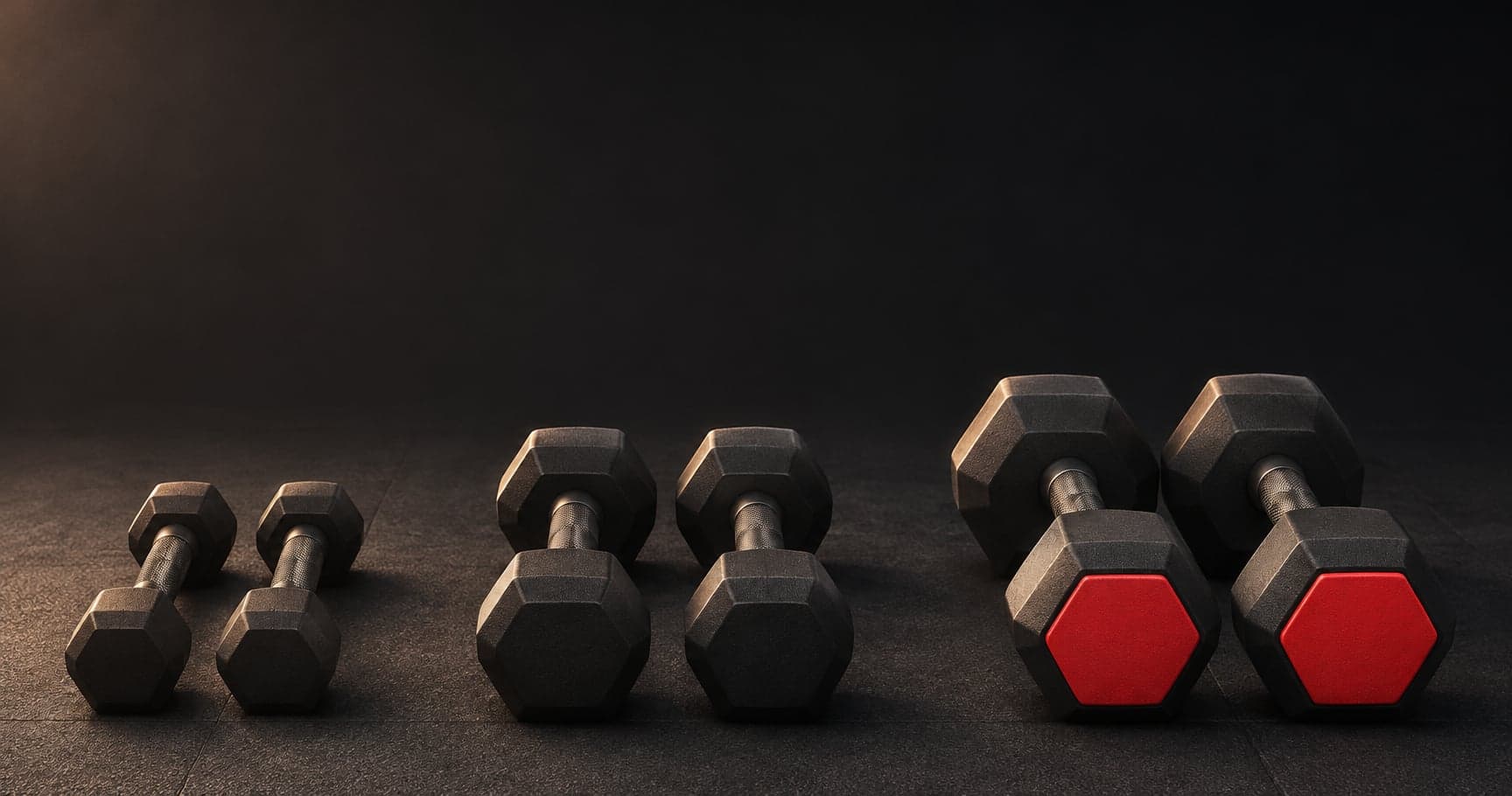
Imagine Jamie already uses two 20 kg dumbbells for a familiar press. Those are the intended working weights for this example. Jamie has previously used the exercise comfortably and knows how to get into position and set the dumbbells down safely. A possible preparation sequence uses lighter pairs before approaching that planned load.
The table labels each dumbbell separately. A pair of 10 kg dumbbells means 10 kg in each hand, with 20 kg combined. Jamie could perform six easy repetitions with that pair, then three with 15 kg in each hand, and two with 17.5 kg in each hand. After resting and checking readiness, Jamie begins the planned working sets with 20 kg in each hand.
These increments are illustrative. Someone using much lighter working weights might need a different sequence or fewer steps. A larger jump, an unfamiliar exercise, or a different equipment setup may justify additional easy practice. Choose available loads you can control rather than forcing a percentage formula onto the rack.
| Stage | Weight per dumbbell | Combined pair weight | Example repetitions |
|---|---|---|---|
| Light practice | 10 kg | 20 kg | 6 easy reps |
| Approach | 15 kg | 30 kg | 3 easy reps |
| Final rehearsal | 17.5 kg | 35 kg | 2 easy reps |
| Working sets | 20 kg | 40 kg | Follow the planned range |
Keep each practice set easy enough to learn from
Use the first light set to check the details that are easiest to overlook. Are your hands secure? Is the seat or bench where you intended? Can you use the planned movement without compensating? If a detail is wrong, put the weights down and fix it before adding load. An easy repetition gives you a chance to notice the setup without making a difficult set the first experiment.
As you approach the working weight, keep the number of practice repetitions modest. You are rehearsing a heavier load, so there is no need to turn every step into another hard set. If the final rehearsal unexpectedly feels close to your limit, pause. Reconsider the planned load and the rest you need before proceeding.
The number of practice sets is a choice, not an obligation to finish a ladder. Jamie does not have to complete the example exactly if the lighter work already reveals that the planned session needs changing. Equally, another brief, comfortable rehearsal may be useful when the setup still feels unfamiliar. Avoid using repeated heavy attempts to force confidence.
Keep the intended effort of your working sets separate from easy preparation. Choose a stopping point for working sets.
Allow a transition before the first working set
After the final warm-up set, take enough time to recover your breathing, arrange the equipment, and feel ready to perform the planned work. There is no single timer setting in this example. A rushed change of dumbbells or an awkward setup can make the first working set harder to interpret. Let the transition include a deliberate check that the correct weights are in place.
If a phone call, equipment queue, or other interruption leaves a substantial gap, reassess before picking up the working weight. A brief easy rehearsal can help you check the movement again. Do not assume the earlier warm-up remains sufficient under every circumstance, and do not automatically repeat the whole sequence simply because the schedule slipped.
When you move to a later exercise, consider what is new about that movement. Earlier pressing does not confirm a new machine seat setting or teach an unfamiliar lift. You may need a light check of the next exercise even when you already feel warm. Keep it purposeful and adapt to the actual transition.
Plan which movement comes first so its preparation has a clear place. Arrange the exercises in your session.
Use consistent rest when comparing your completed working sets. Plan rest between sets.
Label warm-up and working sets in the record
For Jamie, the three practice sets contain 6 + 3 + 2 = 11 preparation repetitions. Those repetitions happened, but they should remain distinguishable from the later working sets. If Jamie then completes three working sets of eight repetitions, the working-set total is 24. Combining them into a single unexplained total of 35 hides the change in loads and purpose.
Use a warm-up label if your logging setup offers one. Otherwise, use a separate dated note or another clear distinction that your system supports. Do not assume the app automatically knows which sets were preparation. Record weight units and whether a dumbbell entry represents one hand or the combined pair consistently.
This distinction also helps next time. If the same working load feels unusually difficult, you can see whether the preparation changed, whether rest was rushed, or whether the equipment was different. None of those details diagnoses the cause on its own, but they make the comparison more useful than a vague memory of having warmed up.
Adjust the plan when preparation reveals a problem
Sharp pain, dizziness, or loss of control are reasons to stop and assess the situation. Adding more warm-up sets is not a treatment for symptoms. Get appropriate professional guidance for persistent pain or a medical limitation. A successful warm-up does not guarantee that an exercise is safe for every person or every day.
For an ordinary session, leave with a simple record of what worked. Keep a preparation sequence while it remains comfortable and practical, then adjust it when the exercise, equipment, or working load changes. You do not need to add a new drill every week to show progress. The useful question is whether you were ready to perform the intended work.
Yoked supports workout planning and double progression, plus set logging and rest timers on Apple Watch. Keep your completed working sets accurate so those records remain useful when deciding what to do next. Preparation should help you arrive at that first working set with a clear setup and a sensible plan.
Base changes in load on comparable working-set performance. Keep progression comparisons consistent.
Sources & editorial notes
Written by Yoked with AI assistance. Examples are starting points for generally healthy adults, not individualized medical or rehabilitation advice.
- Ushirooka et al. (2023), General plus specific warm-up before bench press — Randomized crossover study in 14 men. Adding 20 minutes of cycling to a specific warm-up did not significantly improve measured bench-press repetition or velocity outcomes. It does not establish an ideal warm-up for every exercise or assess injury prevention.